AirCaps Diarization-v1: who spoke when, in real-world audio
Who spoke when: evaluating our model across several public diarization datasets covering far-field multi-talker meetings, telephone conversations, video and broadcast conversations.
00
Abstract
AirCaps Diarization-v1 is a speaker diarization model built for the recordings that matter most and break most models: distant microphones in reverberant rooms, several people talking at once, and conversations that run for hours. It answers the question that speech recognition leaves open: who said each word, and when.
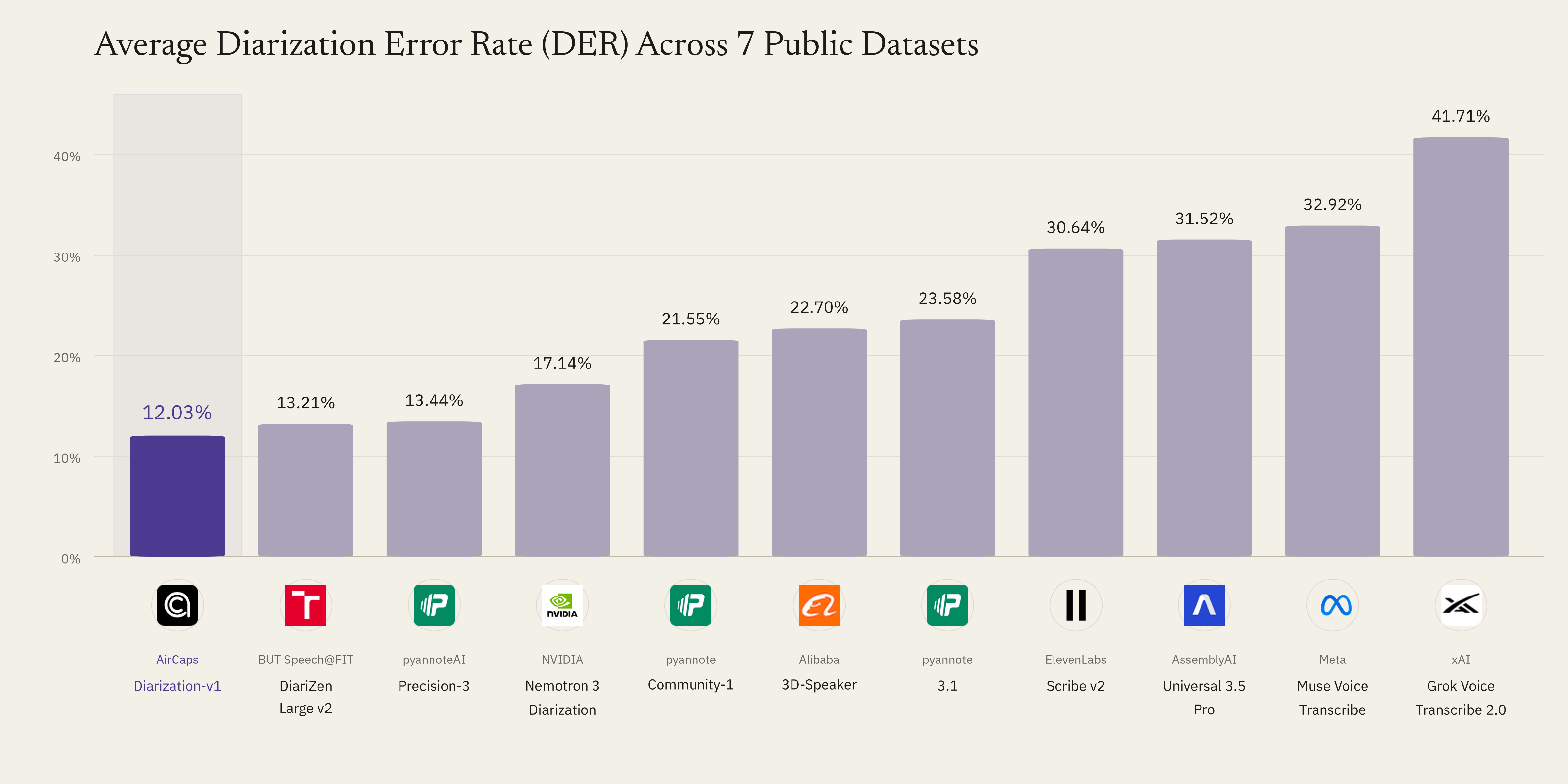
AirCaps Diarization-v1 achieves the lowest average diarization error rate among the 11 systems compared here, including pyannote, DiariZen and Nemotron diarization models and leading ASR providers ElevenLabs, AssemblyAI, Meta and Grok.
Averaged across seven public diarization benchmarks (AISHELL-4, AliMeeting, AMI-SDM, NOTSOFAR-1, RAMC, DIHARD III and CALLHOME), AirCaps Diarization-v1 scores 12.03% DER, versus 13.21% for the next-best model, DiariZen Large v2, and a published 13.44% for pyannoteAI Precision-3. Scribe v2, AssemblyAI U3.5 Pro, Meta Muse Voice Transcribe and Grok Voice Transcribe 2.0 score 30.64%, 31.52%, 32.92% and 41.71%, respectively.
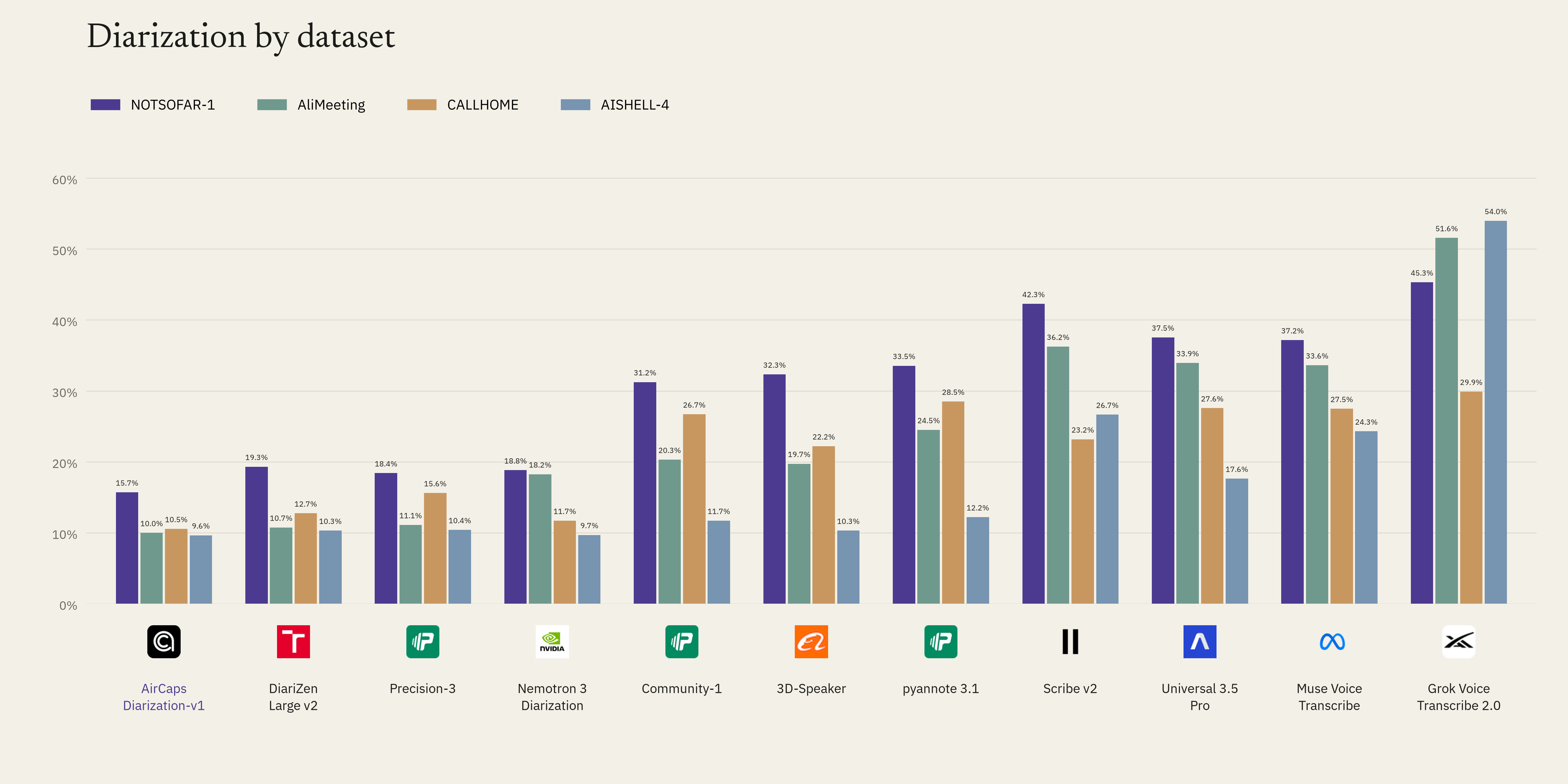
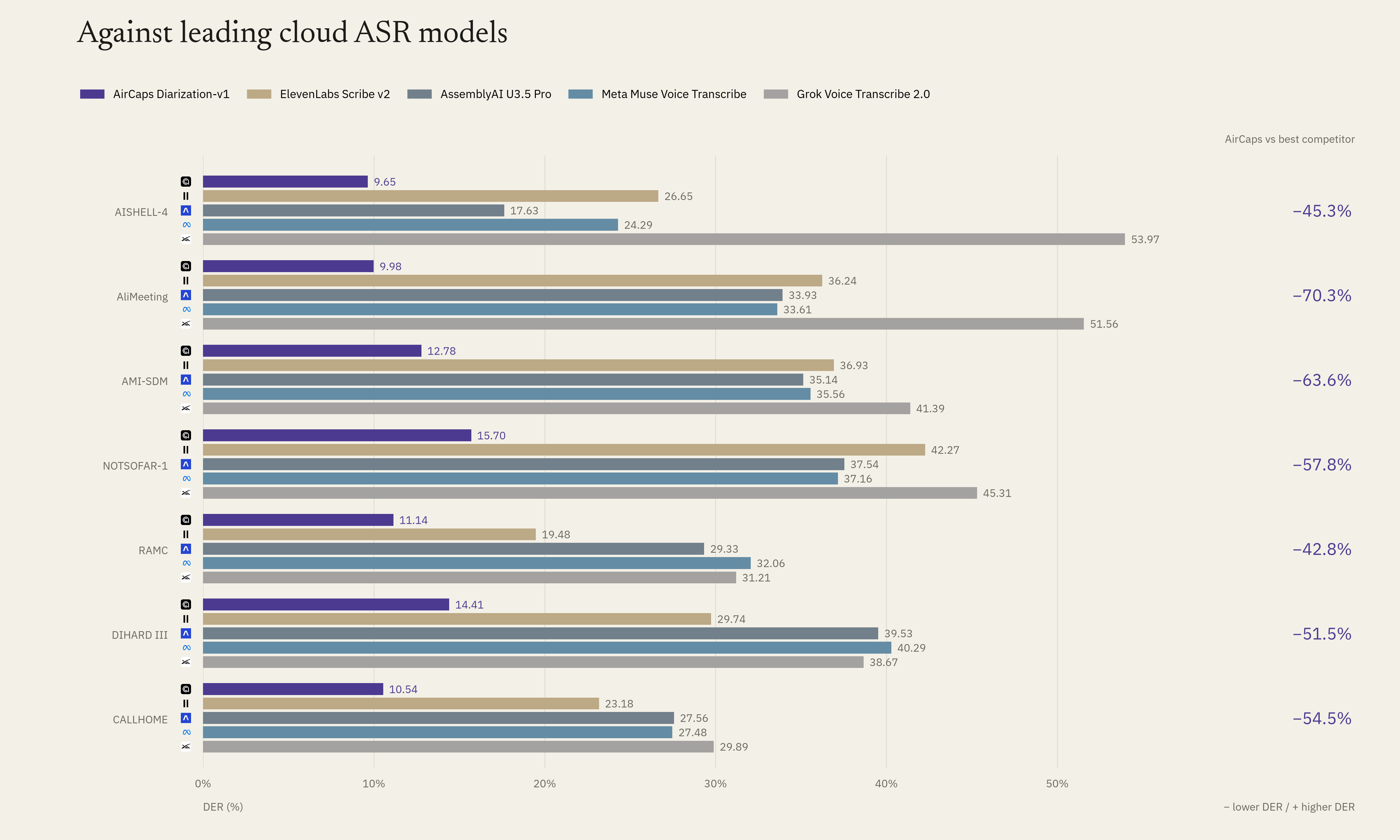
AirCaps has the lowest listed DER on five of seven primary evaluation datasets, including 15.70% on NOTSOFAR-1 and 9.98% on AliMeeting. Across these datasets, AirCaps' model reduces diarization errors by ~9% compared to the next best model, and 42-70% compared to the best cloud ASR providers.
We publish our evaluation code, dataset preparation, and original model outputs in the open-source AirCaps Diarization Benchmark repository.
01
Evaluation Data & Comparisons
Evaluation data
Nine public datasets covering the settings in which diarization is deployed. Each recording is processed whole, from a single channel, with no segmentation, enhancement, or speaker-count hint.
| Corpus | Setting | Audio used | Test recordings |
|---|---|---|---|
| AISHELL-4 | Mandarin conference-room meetings | Eight-channel array averaged to mono | 20 |
| AliMeeting | Mandarin meetings, 2–4 participants | Single far-field array channel | 20 |
| AMI | English scenario meetings | Single distant microphone (SDM) | 16 |
| NOTSOFAR-1 | English office meetings, up to 8 participants | Single conference-device channel | 160 |
| MagicData-RAMC | Mandarin conversational telephone speech | Original recordings | 43 |
| VoxConverse | Broadcast debates, news, and online video | Original recordings | 232 |
| DIHARD III | 11 domains, from clinical interviews to restaurants | Official evaluation set, full partition | 259 |
| CALLHOME | English telephone conversations | Part 2 test conversations | 20 |
| MSDWild | Multilingual in-the-wild video conversations | Official test list | 490 |
Table 1. Fixed corpus selection: 1,260 test recordings. DER is scored with no forgiveness collar and with overlapped speech included, the strictest standard setting.
Selection of comparison systems
We selected ten comparison systems: the 6 diarization models with SOTA performance on our evaluation data, and 4 leading cloud ASR models. The models, developers and official model resources are listed below.
| System | Developer / team | Model resource |
|---|---|---|
| DiariZen Large v2 | BUT Speech@FIT · Brno University of Technology | Hugging Face ↗ |
| Nemotron 3 Diarization | NVIDIA | Hugging Face ↗ |
| pyannoteAI Precision-3 | pyannoteAI | Model overview ↗ |
| pyannote Community-1 | pyannoteAI / pyannote team | Hugging Face ↗ |
| pyannote 3.1 | pyannote team | Hugging Face ↗ |
| 3D-Speaker | Alibaba · Tongyi Lab | GitHub ↗ |
| ElevenLabs Scribe v2 | ElevenLabs | Model overview ↗ |
| AssemblyAI U3.5 Pro | AssemblyAI | Model releases ↗ |
| Grok Voice Transcribe 2.0 | xAI | Model documentation ↗ |
| Meta Muse Voice Transcribe | Meta | Model documentation ↗ |
02
Benchmark Results
| System | AISHELL-4 | AliMeeting | AMI-SDM | NOTSOFAR-1 | RAMC | DIHARD III | CALLHOME | Macro7 datasets |
|---|---|---|---|---|---|---|---|---|
| AirCaps Diarization-v1 | 9.65 | 9.98 | 12.78 | 15.70 | 11.14 | 14.41 | 10.54 | 12.03 |
| DiariZen Large v2 | 10.30 | 10.74 | 13.92 | 19.31 | 10.99 | 14.46 | 12.74 | 13.21 |
| pyannoteAI Precision-3 | 10.40 | 11.10 | 13.50 | 18.40 | 10.50 | 14.60 | 15.60 | 13.44 |
| Nemotron 3 Diarization | 9.69 | 18.25 | 27.66 | 18.81 | 21.13 | 12.72 | 11.70 | 17.14 |
| pyannote Community-1 | 11.70 | 20.30 | 19.90 | 31.24 | 20.80 | 20.20 | 26.70 | 21.55 |
| 3D-Speaker | 10.30 | 19.73 | 21.76 | 32.32 | 22.64 | 29.94 | 22.20 | 22.70 |
| pyannote 3.1 | 12.20 | 24.50 | 22.70 | 33.54 | 22.20 | 21.40 | 28.50 | 23.58 |
| ElevenLabs Scribe v2 | 26.65 | 36.24 | 36.93 | 42.27 | 19.48 | 29.74 | 23.18 | 30.64 |
| AssemblyAI U3.5 Pro | 17.63 | 33.93 | 35.14 | 37.54 | 29.33 | 39.53 | 27.56 | 31.52 |
| Meta Muse Voice Transcribe | 24.29 | 33.61 | 35.56 | 37.16 | 32.06 | 40.29 | 27.48 | 32.92 |
| Grok Voice Transcribe 2.0 | 53.97 | 51.56 | 41.39 | 45.31 | 31.21 | 38.67 | 29.89 | 41.71 |
Table 2. Primary results: DER (%), zero collar, overlap included. Macro is the unweighted mean of the seven displayed datasets. Scribe, Grok, Meta and AssemblyAI use 1.0 s bridging. Some pyannote and 3D-Speaker cells and all Precision-3 cells are results published by the model developers; their partitions and protocols may differ.
Additional datasets
VoxConverse (232 recordings) and MSDWild (490 recordings) are separate from the primary evaluation, due to limitations for some of the compared models.
| System | VoxConverse | MSDWild |
|---|---|---|
| AirCaps Diarization-v1 | 9.32 | 15.27 |
| DiariZen Large v2 | 9.17 | 15.69 |
| pyannoteAI Precision-3 | 8.60 | 15.90 |
| Nemotron 3 Diarization | 15.69 | |
| pyannote Community-1 | 11.20 | 22.80 |
| 3D-Speaker | 11.75 | 27.66 |
| pyannote 3.1 | 11.20 | 25.40 |
| ElevenLabs Scribe v2 | 13.37 | 27.64 |
| Meta Muse Voice Transcribe | 16.28 | 29.96 |
| Grok Voice Transcribe 2.0 | 12.49 |
Table 3. Additional per-corpus DER (%). AssemblyAI is excluded because U3.5 Pro does not support some of the languages in the dataset. Nemotron's VoxConverse score is excluded because NVIDIA lists VoxConverse development and test data in its training datasets. Grok's MSDWild score is excluded because 11 recordings returned empty outputs.
Relative to AirCaps
Seven-corpus macro DER and relative increase versus AirCaps. Relative increase = (system macro / AirCaps macro − 1) × 100; calculated before rounding.
| System | Macro DER · 7 datasets | Relative increase vs AirCaps |
|---|---|---|
| AirCaps Diarization-v1 | 12.03 | — |
| DiariZen Large v2 | 13.21 | +9.8% |
| pyannoteAI Precision-3 | 13.44 | +11.7% |
| Nemotron 3 Diarization | 17.14 | +42.5% |
| pyannote Community-1 | 21.55 | +79.1% |
| 3D-Speaker | 22.70 | +88.7% |
| pyannote 3.1 | 23.58 | +96.0% |
| ElevenLabs Scribe v2 | 30.64 | +154.7% |
| AssemblyAI U3.5 Pro | 31.52 | +162.0% |
| Meta Muse Voice Transcribe | 32.92 | +173.7% |
| Grok Voice Transcribe 2.0 | 41.71 | +246.7% |
Table 4. Relative differences describe the displayed scores, not a reference-independent ranking of model quality. Published baseline partitions and training-label conventions can differ.
03
Examples
Loading audio examples…
04
Methodology and limitations
How we score. We use original dataset annotations, zero collar (no timing tolerance), and count overlapping speech. Each dataset’s DER combines missed speech, false alarms and speaker mix-ups; the headline average weights all seven datasets equally. Our runs use single-channel audio without known speaker counts or reference speech boundaries. CALLHOME is the 20 English Part 2 conversations.
How we ran the models. Scribe, AssemblyAI, Meta and Grok scores join same-speaker segments across pauses up to 1 second, only when no other predicted speaker is active. This brings their timing closer to the original annotations. Meta processed every recording whole, without splitting. Nemotron 3 Diarization uses its offline 30.4-second configuration.
Why reference labels matter. Our meeting annotations, like DiariZen’s recipes, often count short pauses as speech. NVIDIA and VoiceArena use tighter, word-aligned labels. A model trained on one convention can score much worse on the other, so these rankings reflect label choices as well as speaker accuracy. DIHARD III, scored on the same references NVIDIA uses, has tight labels that rarely bridge pauses. That favors models trained on word-aligned boundaries, such as Nemotron, which leads there. Our NOTSOFAR references also differ from the CHiME-8 release used in DiariZen’s published results. See examples and the full explanation.
What was measured. We ran AirCaps Diarization-v1, DiariZen, Nemotron and the four ASR providers ourselves. We also ran 3D-Speaker on NOTSOFAR-1, RAMC, DIHARD III, CALLHOME and MSDWild, and both pyannote pipelines on NOTSOFAR-1. The remaining baseline cells are published figures, whose dataset splits and scoring may differ.
Selection and missing outputs. Nemotron’s VoxConverse test-set training and incomplete AssemblyAI/Grok results explain the additional-table exclusions. AssemblyAI fallback models are excluded; Grok’s one empty DIHARD result counts as missed speech.
05
Sources
- Liesenfeld, Lopez, and Dingemanse. The timing bottleneck: why timing and overlap are mission-critical for conversational user interfaces.
- pyannote. Community-1 speaker diarization: benchmark against pyannote 3.1.
- pyannoteAI. Precision-3 benchmarks.
- Han et al. DiariZen: speaker diarization toolkit and model results.
- Alibaba. 3D-Speaker speaker diarization results.
- NOTSOFAR-1 Challenge: new datasets, baseline, and tasks for distant meeting transcription.
- Carletta et al. The AMI Meeting Corpus.
- Ryant et al. The Third DIHARD Diarization Challenge.
- NVIDIA. Nemotron-3-Diarization model card, configuration and training disclosures.
- NVIDIA. Nemotron diarization release and evaluation.
- VoiceArena. Diarization-Bench methodology.
- NTT. Forced-aligned AMI and AliMeeting references.
- Detailed evaluation notes ↗
06
Evaluation notes
Why speech boundaries change the scores
Diarization depends on what the reference labels call speech. Original meeting annotations often include short pauses within an utterance. Word-aligned labels tend to mark those pauses as silence. A model that spans a pause can be correct under the first convention and produce a false alarm under the second; a model that removes it can instead accumulate missed speech against the original labels.
Our evaluation follows original dataset annotations, including the AMI and AliMeeting convention used by DiariZen’s recipes. NVIDIA uses word-aligned labels for AMI, AliMeeting and NOTSOFAR. VoiceArena also uses alignment and human review, with silence boundaries above 200 ms. This makes comparisons across those evaluations sensitive to label choices.
For example, Nemotron 3 Diarization scores 27.66% DER on our AMI references, including 24.92% missed speech. That gap should not be read entirely as a difference in speaker recognition. DIHARD III uses the same reference release as NVIDIA’s evaluation, and its labels are tight: most short pauses are marked as silence, much as in word-aligned labels. That convention favors Nemotron, which leads there, 12.72% versus 14.41% for AirCaps Diarization-v1. About half of that gap is false alarm in pauses shorter than one second, where AirCaps Diarization-v1 keeps the speaker active; most of the rest is speaker confusion. AirCaps Diarization-v1 has not been evaluated on VoiceArena.
Our official NOTSOFAR references also differ from the CHiME-8 release used by DiariZen’s authors, which omits filler-only utterances. Their published 16.7% and our measured 19.31% therefore describe different references.
Scoring, averaging and dataset splits
Each dataset’s DER is total missed speech, false alarm and speaker-confusion time divided by total reference speaker-time. Overlap is counted, and the collar is zero: no boundary tolerance is removed from scoring. The primary average gives each of the seven datasets equal weight rather than weighting by recording count or duration.
The primary evaluation contains 538 recordings. CALLHOME uses 20 English Part 2 conversations; this differs from NVIDIA’s multilingual evaluation and its 0.25-second collar. VoxConverse and MSDWild add 722 recordings and are shown separately. Our runs use single-channel audio without reference speech boundaries or known speaker counts.
We ran AirCaps Diarization-v1, DiariZen, Nemotron and the four ASR providers. We also ran 3D-Speaker on NOTSOFAR-1, RAMC, DIHARD III, CALLHOME and MSDWild, and both pyannote pipelines on NOTSOFAR-1. Other baseline cells are authors’ published results. Averages containing those cells may combine different dataset splits or scoring details.
Inference and pause handling
Scribe, AssemblyAI, Meta and Grok predictions use one fixed post-processing rule: merge overlapping segments from the same speaker, then bridge gaps up to 1.0 second only when no other predicted speaker is active in the gap. These are post-processed scores rather than native provider scores. The rule brings word-timed outputs closer to the original annotations.
Meta processed all 1,260 recordings whole, without splitting. Nemotron 3 Diarization uses the offline configuration with a 30.4-second input buffer, 16 kHz audio, BF16 and batch size 8. Its buffer settings are speaker cache 264, FIFO 40, chunk 340, right context 40 and cache update period 300, in 80 ms frames. 3D-Speaker uses its standard pipeline with overlap enabled; Community-1 uses its regular overlapping-speaker output.
Model selection and excluded results
Nemotron’s VoxConverse score is excluded because NVIDIA discloses training on VoxConverse’s test set in its model card. AssemblyAI is excluded because its target-model coverage is incomplete on both additional datasets; responses from fallback models are not included.
Grok’s MSDWild score is excluded because 11 recordings returned empty outputs. Its one remaining empty DIHARD response is counted as no speech, so all reference speech in that recording contributes to missed speech. Its DIHARD score and primary average include that penalty.